On January 14, 2025, Michigan Technological University (MTU) hosted a focus group titled Collaboration & Community Engagement in collaboration with Keweenaw Community Foundation, bringing together community members, nonprofit representatives, and MTU faculty to explore opportunities for meaningful partnerships. The event, led by Cassandra Reed-VanDam (Essential Education Experience Manager), aimed to bridge the gap between academia and the surrounding community, creating a framework for future collaborations that are mutually beneficial and impactful.
A new type of course that addresses the Contribute/Transform Learning Goal in Essential Ed – it refers to an initiative designed to integrate real-world, experiential learning opportunities into academic and community settings. This program aims to equip students with practical skills, foster meaningful collaborations, and address pressing community challenges through partnership-based projects. It emphasizes the development of leadership, communication, and problem-solving abilities essential for professional growth and societal impact.
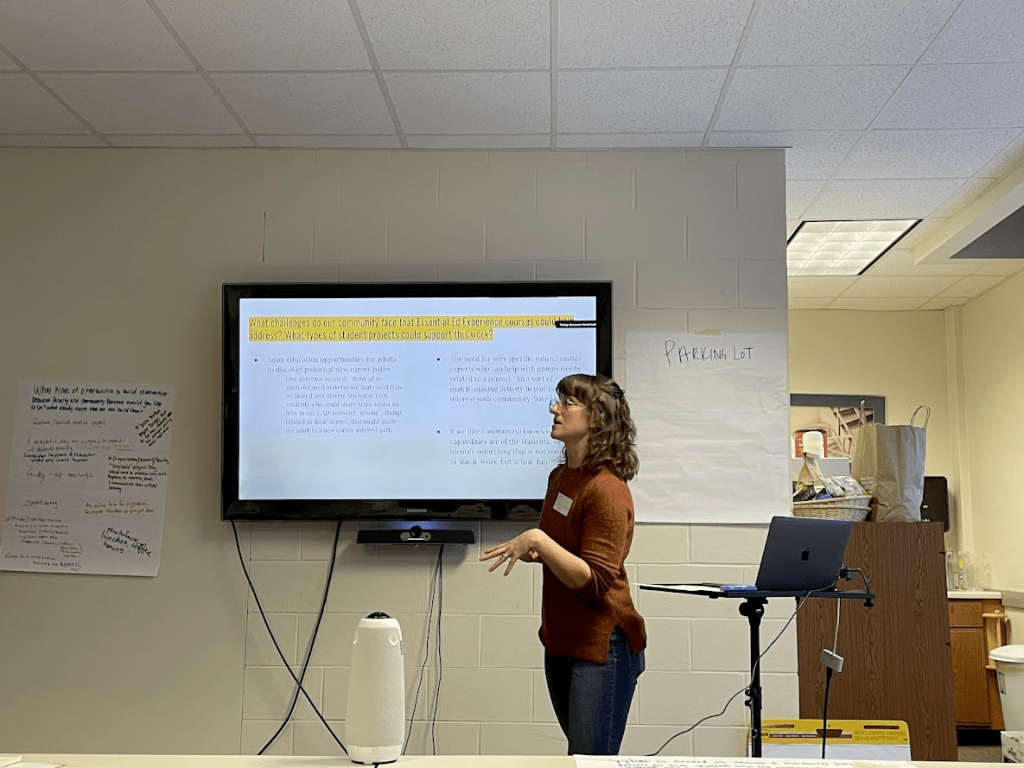
First, what is Essential Education?
Starting Fall 2025, Essential Education is replacing Michigan Tech’s current general education requirements. Forward-thinking, student-centered core education curriculum structured around four learning goals and 12 Essential Abilities—the critical skills that tomorrow’s workforce needs.
- Think Critically
- Communicate
- Adapt
- Contribute/Transform
“At Tech, we believe it is our responsibility to ensure that Huskies are prepared to enter and succeed in this changing world. Essential Education will give them the tools they need to become the culturally responsive, civically engaged leaders tomorrow needs.”
Key Discussion Points
The group addressed several pertinent questions about the upcoming Essential Education Experience (E3) initiative at MTU:
- How will the program integrate with student coursework?
- What support structures (e.g., funding, resources) will be in place for participating organizations?
- How can community organizations propose projects, and what criteria will be used to select them?
- Will there be opportunities for high school students, retirees, and other community members to participate?
Participants highlighted successful past collaborations as inspiration for future projects, such as:
- MTU students working with AmeriCorps over the summer to enhance the local MakerSpace.
- Developing interactive museum exhibits at Eagle Harbor Lighthouse.
- Business consultation services provided by MTU interns through partnerships with the Small Business Administration (SBA).
Challenges and Solutions
The discussion also delved into challenges and solutions to ensure effective collaboration:
- Challenges:
- Misaligned expectations between students and organizations.
- Limited time and resources for nonprofits to onboard and guide student participants.
- Funding constraints and transportation barriers.
- Proposed Solutions:
- Clear expectation-setting and communication channels between students, faculty, and organizations.
- Developing a project agreement form to outline roles, responsibilities, and goals.
- Offering workshops for community partners to help them design impactful, feasible projects.
- Leveraging MTU’s GivePulse platform to streamline volunteer matching and project proposals.
Community Impact and Future Directions
The focus group concluded with actionable steps to strengthen community-university collaboration:
- Launching a Nonprofit Day on campus to connect students directly with organizations.
- Establishing a catalog of nonprofit opportunities to inspire students and faculty.
- Exploring long-term projects that extend beyond a single semester to ensure sustained impact.
As MTU moves forward with the E3 initiative, events like these serve as vital platforms to align goals, share knowledge, and foster partnerships that benefit both the university and the community it serves. Together, we can tackle pressing challenges, from accessibility issues to educational disparities, and create a brighter future for all.
For EBLP readers, if you are interested to view the presentation given that day, you can view it in here and learn more about Essential Education curriculum in here.
 Elaine Bacon Literacy Program