
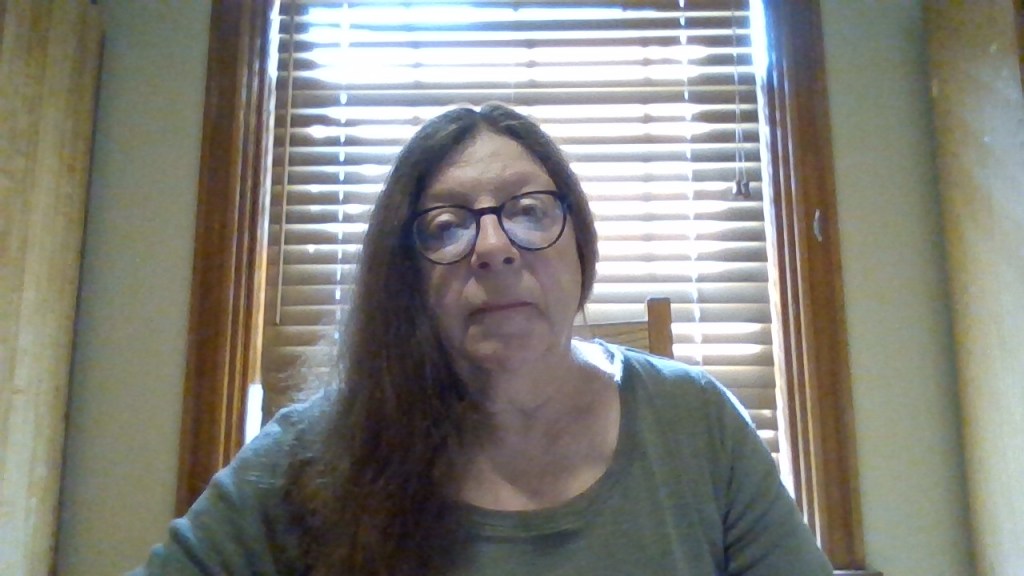
Let’s welcome our new tutor, Laurie Corbin! She will share how she joined the EBLP and her tutoring story!
How I joined the EBLP
Having recently retired from teaching French at the university level for my entire career, I was very happy to learn of the Elaine Bacon Literacy Program. Language and literature—our abilities to speak and understand others when they speak, to read and write—have been important to me my entire life and when the opportunity came to continue to share the joy of these abilities with others, I immediately agreed.
And then it happened that there were several requests from French speakers for tutoring in English so this was a pleasant reversal of what I had done for so long—taught French mainly to native speakers of English and now I would teach English to native speakers of French. All three students—Azilis and Zoé are interns at a non-profit in Hancock and Gaetan lives in L’Anse and works from home—wanted to work on their pronunciation.
Learning about my native language
I have always enjoyed teaching French pronunciation to students learning French, showing them the mechanics of how to use the muscles of the face, the lips, the tongue, the entire mouth to form sounds that exist in French that do not exist in English. It can be a silly part of the class where we have to break through some self-consciousness to learn to make these new sounds. And I can recall how I learned these sounds so long ago, studying French in the United States, in Canada, in France and I remember specific moments of understanding how to have a comprehensible accent in French.
However, it didn’t take long for me to realize that I had no idea how to teach Francophone people how to pronounce English. I have simply never thought about it. So, Denise Heikinen very kindly lent me an excellent book called Well Said (I now have my own copy) and I started to learn about the sounds that we have in English that do not exist in French. And also, the sounds that are difficult to distinguish between for non-native speakers of English. And also, how the stress on a syllable makes a huge difference to comprehension and can even change the meaning of a word.
First, I had to think about the fact that there are sounds in English—particularly [th] and [h]—that are difficult for people who are native speakers of French since these sounds do not exist in French. Moreover, these two sounds, if not clearly pronounced, can make it very hard for listeners to understand what is being said. One of the first sentences that I created for practice (I asked my students to say this sentence constantly to someone in their household, I am not sure that they ever did and that is okay) was: “Throughout their time together they always thought of each other first.” If you look at this sentence and you try to imagine how it would sound if the [th] was always pronounced as [t] or even [f], you can see the problems of comprehension that could result.
But what is interesting about these two sounds—[th] and [h]—is that the problem is what I would call mechanical: once you understand that to pronounce [th] it is necessary to place the tip of the tongue right beneath the front top teeth and force a small amount of air between teeth and tongue, you are able to make that sound. Similarly with [h]: once you understand that to pronounce an [h] at the beginning of a word, you have to slightly expel air from your lungs into your mouth to say words such as “here,” “he,” and “has,” it is not hard to start saying these words clearly.
The problem with vowels is different: there are some vowels that are not always easy for French speakers to distinguish between even though they exist in French, for example, the sound [ee] as in “peach” and the sound [i] as in “pitch.” Think of some embarrassing examples of mixing up these two such as saying “beach” but using the [i] sound! And having worked with many native speakers of French in different academic environments, I can assure you that these mistakes are not uncommon. And you don’t want to make that kind of mistake in a business meeting!
Finally, we have begun working on the stress on syllables. In French it is almost always the final syllable of a word that is stressed. I had never thought about the fact that in English, the stress on syllables can be anywhere and there seem to be very few rules to help us understand if we are supposed to stress the first syllable, the second, the third, the last…it is confusing! And it can make quite a difference if you think about the fact that when we say “present” with the stress on the first syllable it is a noun, “I gave her a present for her birthday” or an adjective, “He was present for the concluding speech,” but when we say this word with the stress on the second syllable it is a verb, “Allow me to present my friend Alex.” And there are other words in English just like this.
The text Well Said has been invaluable to me as I have begun learning how to work on these aspects of pronunciation as well as others. Each chapter begins with a small diagram showing how the mouth, tongue, and lips are used in making different sounds. This image is extremely helpful to students trying to distinguish between [th] and [t] or [ee] and [i]. The book also has many exercises which we have used for work on their pronunciation and their comprehension of different vowel sounds or where the stress falls in different words. My students have different goals for themselves as far as how they want to use their English in the future but I can see that they are aware of the progress they are making and pleased with new successes in their ability to speak English clearly.
Looking ahead
For the future, I might not always have Francophone people who come to the Elaine Bacon Literacy Program for help with their English pronunciation or grammar, but this has been a great start for me as a tutor. My students are proud of their new abilities and I am having a lot of fun learning about my native language and how to help people gain a feeling of confidence when they use it.

